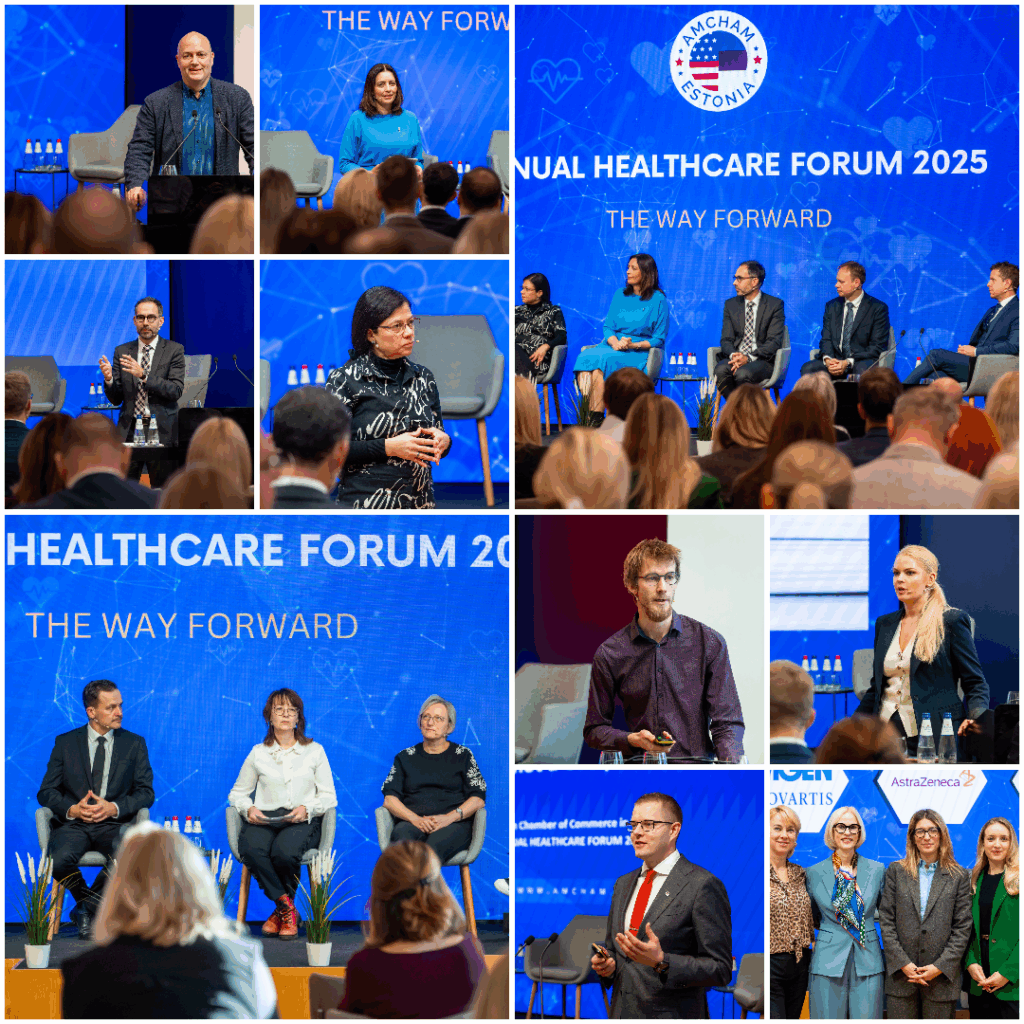
AmCham Healthcare Forum 2025 Highlights the Billions Hidden in Smart Health Investments
The ninth annual AmCham Healthcare Conference brought together a remarkable lineup of Estonian and international experts, all converging around one message: Estonia can no longer afford not to invest intelligently in its healthcare system. Held against a backdrop of rising healthcare deficits, an ageing population, and a heavy national disease burden, the conference delivered both a sobering diagnosis and a hopeful prescription.
From the outset, the tone was set by the stark economic realities outlined by multiple speakers. Estonia’s healthcare expenditure—just 7% of GDP compared to the EU’s 10.4% average—was repeatedly cited as unsustainable given the mounting demand. The Health Insurance Fund’s deficit, currently at 160 million euros and projected to balloon to 900 million by 2035, served as a stark reminder of the urgency.
Healthy Years as the Ultimate Currency
Social Minister Karmen Joller delivered one of the event’s most resonant insights: the true battleground is the number of healthy years people live. Prevention, early detection, and efficient treatment were emphasized not as ideological preferences but as economic necessities. Joller argued convincingly for a shift from service-based financing to a value-based model—one that rewards actual health outcomes rather than volume of services.
This theme of value echoed throughout the day.
Data as the Missing Ingredient
Hanno Püttsepp of AmCham highlighted a paradox that many in the room seemed to recognize: while society increasingly agrees healthcare needs more funding, the system still lacks the clarity to invest wisely. Better data—and better tools to interpret those data—were identified as essential before any major financial injections.
The McKinsey Wake-Up Call
Alex Beauvais of the McKinsey Health Institute delivered what was perhaps the most impactful keynote. He noted that although life expectancy has climbed globally, many of those additional years are spent in poor health—an issue painfully visible in Estonia’s figures. His prediction that Estonia could lose 13 billion euros in annual tax revenue by 2050 if current trends continue drew audible reactions from the audience.
Yet Beauvais also offered hope: every euro invested smartly into healthcare could return fivefold, especially in areas like cardiovascular disease, cancer, and neurological conditions. His message was clear: the problem is enormous, but the opportunity is even greater.
Health Data and Innovation: Estonia’s Untapped Advantage
Ahti Kuningas of the Ministry of Economic Affairs and Communications built on this by arguing that Estonia is sitting on a goldmine of health data—one that remains largely underutilized. Properly leveraged, these data could accelerate early disease detection, support innovation, energize startups, and make Estonia a competitive hub in health technology. It was a vision of healthcare not as a financial burden but as an engine of economic growth.
A Conference That Connected Dots
What made this year’s conference particularly compelling was its ability to connect macro-level economic forecasting with practical, actionable strategies. Discussions moved fluidly between population statistics, financing models, data ecosystems, and real-world innovations. The diversity of perspectives—from government leaders to global analysts—gave the event a richness that extended beyond typical healthcare policy discourse.
Verdict: A Timely, Insightful, and Urgent Gathering
This year’s AmCham Healthcare Conference succeeded not only in raising critical issues but in reframing the national conversation around healthcare. Instead of viewing health spending as a cost center, speakers made a powerful case for seeing it as a long-term investment capable of generating billions in economic value.
If Estonia takes to heart the ideas presented—especially the shift toward value-based care, better use of data, and targeted prevention—the conference may well prove to be a turning point. The message was unanimous and unequivocal: smart healthcare investment is not just good medicine; it is smart economics.
> Healthcare Forum Program 2025
